Showing posts with label religion. Show all posts

Wednesday, December 5, 2007

On blasphemy laws
A reasonable test of a nation's commitment to liberal democracy is the existence or otherwise of a blasphemy law on its statutes.

A reasonable test of an individual or organisation's commitment to liberal democracy is their willingness to bring a blasphemy suit against another individual or organisation.


On Foucault
I think the validity of Foucault’s work depends to a great degree upon how you approach it. Foucauldian theory as science? Category mistake. Foucauldian theory as a way–but certainly not the only way–of storytelling/interpreting history and culture? Far more valuable.


On Plato
What assumptions do I have about Plato? Not being very knowledgeable about him, just this one: his concept of Forms constitutes maybe the greatest blind alley in the history of Western philosophy, and has been an absolute boon to magical/dogmatic thinking for millennia.


(UPDATE) On the mall shooting
I blame secularism. Not for any good reason, mind you--I just wanted to get in ahead of the conservapundits. (Or have I already been beaten to the punch?)


The Simpsons and Philosophy


Sesame Street and Philosophy


Monty Python and Philosophy


Ben Folds and Philosophy

The week in fundie . . .

  1. The Unintentional Irony award goes to the opponents of the International Baccalaureate curriculum at a high school in Upper St Clair, Pennsylvania, who appear to be of the view that it comes straight from Chairman Mao:
    "The IB program is anti-American. It does not teach the basic patriotic values of the United States," said Judy Brown, 64, a retired merchandising and sales representative who has a daughter that attended Upper St. Clair schools. "It's almost like brainwashing."
    A hostile board member was heard to utter:
    "Faith is certain. It is more certain than all human knowledge because it is founded on the very word of God who cannot lie;" and, "Jesus Christ as the redeemer of man is the center and purpose of human history. That is why all authentically religious tradition must be allowed to manifest their own identity publicly, free from any pressure to hide or disguise it."
    Got that? Not forcing Jeebus and flag-waving patriotism down the throats of students constitutes "brainwashing." (Pittsburgh Tribune-Review)
  2. A Catholic bishop in Chicago is seeking legal changes that would shield Church institutions from having to pay out "excessive damages" in sex abuse lawsuits, on the grounds that they "jeopardize the mission of the church" and hence "place an excessive burden on the free exercise of religion for American Catholics." Oh, please. If the Catholic church wishes to minimise the damages resulting from sex abuse lawsuits, the answer is absurdly simple: it needs to stop engaging in or sheltering the perpetrators of sexual abuse. (Chicago Tribune, via the Atheist Experience)
  3. Sherri Shepherd, who is proving herself to be someone you want in your corner should you ever find yourself playing team Trivial Pursuit, opines: "I don't think anything predated Christians." The Greeks? The Romans? "Jesus came before them." Shepherd is quite the polymath: not only is she full-bottle on world history, she's also formidable on the earth sciences. (The Huffington Post, via Pharyngula)
  4. Florida's Palm Beach Community College refuses to provide health benefits to same-sex partners of its employees. It is more than willing, however, "to offer workers insurance for their pets." (365Gay.com, via Morons.org)
  5. A Saudi appeals court judge has threatened to sentence a rape victim to death if she appeals against her current sentence of 200 lashes and six months in prison for "illegal mingling" with an unrelated male. (via Bartholomew's Notes on Religion)


Just to make it worth your while . . .

Pat Condell on Catholic morality


The videos of this year's Beyond Belief conference are now available online.

Tuesday, December 4, 2007

Just quickly--Rae at Subversive Muse has written a series of posts "from a critical left-wing perspective" on atheism, science and religion. I've expressed my objections to Rae's arguments--I think they basically misrepresent science (it is taken as axiomatic in this series of posts that science is "an ideology," whereas I think this needs to be argued for/demonstrated) and critique a strawman definition of atheism--and I know Bruce (who is more well-versed on this topic than I am) is preparing a response at his blog. Brian at Primordial Blog has written a thoughtful response as well.


Just to make it worth your while (and Rae, I'm not lumping you in with these guys!), here are some Youtube dispatches from the war on science:

"The Evangelical War on Science"


"The Republican War on Science"

Monday, December 3, 2007

Catch The Fire has been getting a lot of traffic, it appears, since it became apparent to all and sundry that God/Pastor Nalliah backed the wrong horse in the recent Federal Election. The administrators appear to have relaxed their unstated ban on critical comments, for now, and you can find some of those at the end of this post. But most of the following extracts of comments are from true believers, responding to Nalliah's "explanation" for the miserable failure of his pre-election prophecy. I've separated them into categories . . .

Why, God? Why?
Many people from a number of Churches were gathering over a period of time and praying taht “God’s will would be done at this election”.

Does God not place any value on our prayers? (Richard--who I suspect might be one of ours)


Stock-standard lunacy
Apparently a psychic predicted a Rudd win. That alone tells me what Rudd is about and that I don’t want to be on side with these occult voices. (Aurora)


We were spoken to through Judges 20 in that there must be determination that the battle must continue, regardless of the defeats, for in this passage the Lord says go up, but they were slaughtered – and yet they came together as one nation – almost – at the time. Later you find they were not all together – there were still those who were not with them in chapter 21. But God gave them victory regardless – the third time. We also had a dream of 3 snakes which looked fierce but were easily destroyed. So, we continue to pray the prayers we were supplied with before the election, but must now pray them in the context of what the Lord will do. He is the God of miracles. (Ken & Adrianne)


I agree with what you have said, and I must admit when I heard the news of Labor’s victory, I was led to read from Lamentations. I believe God was grieving as I was. (Trisha)


Lawyering for Jesus
Some people may not be aware that prophecy is conditional: upon both prayer and obedience.(Pastor Marilyn McKenny)


I noted that when you declared what the Lord had told you, you included the word “IF”. While some would see this as a disclaimer for you to dodge criticism should the prophetic word not come to pass – the “IF” is meant to be an encouragement & motivation to the Church. 2 Chron 7:14 is an example of this type of condition. “IF my people….. etc”. Obviously, the condition was not met.(Pastor Bob Cotton, another Lawyer for Jesus)


We have had situations the same , where God made his will known but it went the other way because no one was listening or prophecies were misinterpreted through poor theology, or prayer was weak . (Des & Christine Gibson)


…. you did not get it wrong….. we the body of Christ did - oh for ears that will listen. (Allen Moore)


Thankyou O servant of the Most High God.
I don’t believe you got it wrong. I’ve never heard God say “oops”. (Robyn)


A while ago, before I knew of your election prophecy I had a vision of John Howard standing defeated he was a broken man in my vision weeping and worn out. It then troubled me because of what your prophecy had declared, I thought how could 2 opposite things come from the same source of eternal truth?

After you had pointed out that the lack of unity in the Body was the cause for Labor’s win (and many other problems we are facing) it brought a sense of peace(knowing that this vision was correct and from our Lord) and sadness too for I had wanted the Liberal party to win also. (Andrew, on how the power of Christ can resolve glaring contradictions)


Denial ain't just a river in Egypt
The people have demanded a king and God has given us one (I Sam 8) . You, the prophet, has faithfully warned the nation, but God is preparing David, even while Saul is in power. (Jill)


As to your question did I vote them in no I personally didn’t, I advised people who would listen and my children to vote family first so as not to go down the road of lust and lies in human nature so called…. My children listened but most others didn’t, while handing out how to vote cards for family first only over a period of 2 hours 2 people only asked for family first the rest graciously took all information handed to them.
Sadly we now have a party that tends to sway against biblical values and advise, but like the good book says it is our job as believers to continue to pray for the government elect and let the Lord God Jesus stir their waters and relies their ways, not to implement change that will bring the Christians
Down as God the Almighty will not allow this to happen and bad times will fall upon them in sickness and decease (Argument from consequences from Sharon)


The Lord said to me the problem is the state of the hearts & the sin of His people who are blinded and have voted foolishly, so the Lord will have to allow the people to learn the hard way & to actually have to wake up by personal suffering & experience….
I too and many ohters I have spoken to suffered greatly on that first night really struggling with the Lord…and on Sunday night, the Lord lead me to Jn 11 and the Lazarus story, yet again (Emphasis and hyperlink added. Very cheeky, Hilary)


Praise the Lord and pass the tinfoil
I think we actually are going to experience some things that we need not have endured… ( like the 40 years in the wilderness.. due to the idolitary etc.. .. reminds me too ” oh foolish Galations.. who has bewitched you”…)
I also really feel deeply for John Howard,. (Me too, Marg. Me too.)


Very well written - couldn’t agree more; this nation is headed straight toward end times and has joined the ranks - need we have been surprised? (John & Louise)


I could hardly sleep last Saturday night for anguish as to what was happening in the election. I saw the jubilation from the Labor camp as releasing a demonic flow over the country, a vicious rabble that had been waiting, scrapping behind the starting barriers, to burst out upon their legal release: the announcement of Labor victory. They knew they were about to get freedom. They had already cornered and achieved confusion in Howard who, not having enough knowledge or power through the Holy Spirit, had crumbled on some major as well as minor issues, providing further fuel for the blind amongst Christian brothers and sisters to vote against him.(Clare)


Some months before the election I talked with a spirit-filled pastor who has a lot of contact with parliamentarians in Canberra. Not long beforehand he had been phoned up by Kevin Rudd asking for prayer. It wasn’t my place to ask more, but the pastor volunteered that Kevin Rudd was unequally yoked to Julia Gillard. She represents the socialist left wing of the Labour Party. While not electable in her own right as a Prime Minister, I expect she will use her anti-Christian influence as Jezebel did through Ahab. (Malcolm McCaskill)


Your reference to “wolves in sheep’s clothing” is particularly appropriate as this is the tactic used by the Fabian Society in the world and Australia - to subtly infiltrate the key areas of society and gain social change and power. I understand that the Fabian Society’s original symbol was a wolf in sheep’s clothing but was changed as this was too obvious to what they were on about. The Fabian Society has a long history of anti-Christian activity (including shocking acceptance of depraved sexual practices), and I understand that the current membership of the Australian branch is composed of Gough Whitlam (president) and a number of former Labor prime ministers. The Fabian Society’s links and debt to Lenin is alive and well, and their influence on the Labor spirit is also alive and well.

The Labor Party is actually not a political party at all - it masquerades as one. It is a religious party with its doctrine being humanism, atheism, and naturalism, and its god is man (that is, the glorification of man to solve all problems in the world and society to the blasphemous exclusion of its Creator - God). (David)


Theocracy
The Father did not ask His Children for much, not as much as His has asked of others; He did not ask us to be imprisoned for this election/He did not ask us to give our life for this election/No, all He asked was that we follow His Will (He wasn’t taking our freedom of choice He would never do that, He gave us a choice: Follow His Will/Don’t follow His Will)…it was all very simple what He was asking His people.

We as the Father’s Children were meant to stand in the gap for those who don’t know Him. (Cindy. That's chilling.)


But I wonder how long the following comments will last . . .

Thank you for the explaination. But why are you so frightened by the ALP win?

I am a Christian - and I don’t believe I have to be Right-Wing to be so. I probably did not vote the way you did. Does this mean, in your mind, that I am not a listening, committed Christian.

I have close connections with your home country Sri Lanka. And I have seen what awful things happen in that nation when the Buddhists try to be involved in politics.

You claim that your prophecy regarding John Howard being elected was stymied by the Christians who did not agree with you. Were they not listening to God?

It is right that we test prophecy. I am sure you agree. Do you know that many Christians and Christian leaders in this nation were praying for an end to dishonest government and trusted that God would work through Kevin Rudd, another Christian?

Are we wrong and you are right? Have you seriously searched your heart about this? (Bryan)


I thought the correct answer was YES I did get it wrong!!!

However you won’t publish any comments that differ from your point of view.

Thank God that His wisdom is greater than your’s. I will pray for you. (Rod)


Danny,
I know the Lord has plans for good for all who follow his word and accept his son Jesus. You spoke at my church and I believe your prophesy extended to Peter Costello. Could you please comment.

Also you published on your website a prophesy of Kenneth Copeland:

“God’s man in Australia stood up and publicly declared Australia a Christian nation! ‘If you want to come here and join us in our Christian faith you are welcome here but don’t think you can come in here and try and force some other religion here on us and don’t think you are going to tell us how to believe God and who we are going to worship.’ He publicly did that,

now this is no time for that man to be defeated. Well he’s not going to be. Amen.

He is Lord to the glory of God the Father. He is Lord to the glory of God the Father. He is Lord over Australia! It has been announced! Amen.”

It would appear this prophesy was false? Could you please comment. (Brendan Willis)


Commenter James Garth published his "Open Letter to Pastor Nalliah" on his own blog.

I understand that there are historical reasons why when the Pope holds forth on a given topic, the world's media bends over backwards to report it. After all, his predecessors were once upon a time the most powerful leaders in the world. And yet it still bothers me that his banal brand of magical thinking is deemed newsworthy.

His latest encyclical, Spe Salvi, is being represented by many media outlets as a scathing attack on atheism, in response to the success of recent atheism-themed books by Sam Harris, Christopher Hitchens, Daniel Dennett and Richard Dawkins. Talk about being hit with a wet newspaper . . .
The atheism of the nineteenth and twentieth centuries is—in its origins and aims—a type of moralism: a protest against the injustices of the world and of world history. A world marked by so much injustice, innocent suffering, and cynicism of power cannot be the work of a good God. A God with responsibility for such a world would not be a just God, much less a good God. It is for the sake of morality that this God has to be contested.
Do we not hear in these words the echo of a thousand online "concern troll" theists? "I understand: you're an atheist because you're angry at God. It can't possibly be because of the lack of evidence that a God exists. So it must be the anger thing."
Since there is no God to create justice, it seems man himself is now called to establish justice. If in the face of this world's suffering, protest against God is understandable, the claim that humanity can and must do what no God actually does or is able to do is both presumptuous and intrinsically false. It is no accident that this idea has led to the greatest forms of cruelty and violations of justice; rather, it is grounded in the intrinsic falsity of the claim. A world which has to create its own justice is a world without hope.
No, Benedict: a world which has to create its own justice--and is aware of that fact--is a world that has finally weaned itself off the teat of religious dogma, cast aside the security blanket, and grown up. The cruelty and violations of which you speak--namely those caused by totalitarian regimes in the twentieth century--are simply the fruits of one set of dogmas being replaced with another. I'll say that again so that it might sink in. The cruelty and violations of which you speak are the fruits of dogma, not atheism. Your mistake is in your severe tunnel-vision, which is such that you cannot begin to countenance the thought that we might cast aside dogmatic thought altogether.

Thursday, November 29, 2007

God: Attorney At Law

Pastor Nalliah's first post-election contribution to the Catch a Fire blog is titled:
Election 2007 - Did I get it wrong?
Yes, you did, Danny. Yes, you did.

Ordinarily you would expect someone who has been as comprehensively embarrassed by the facts as Nalliah to pack up his revival tent and slither away quietly into the night with what remains of the smoking ruins of his credibility. But Nalliah still has gallons of snake-oil to sell, and legions of gullible halfwits who are simply gagging for the stuff. And so he returns to "help you in better understanding the results of the Election 2007."

He opens with persecution mania and an appeal to pity. In spite of "the fiery storm of accusation, criticism and persecution," [INSERT BIBLE VERSE HERE], God has given Danny broad enough shoulders "to cop quite a bit of flak." Nonetheless, "the weekend of the election was one of the worst weekends in my life." Why? Because God's anointed vessel John Howard had just suffered a massive defeat in the polls, and to top things off, Nalliah's father-in-law in Sri Lanka had taken seriously ill. "Bible believing Christians struggle not against flesh and blood, but wrestle against principalities and powers of spiritual darkness," and Satan--the fucker--had just delivered the Nalliahs a double-whammy.
Immediately I said, “Lord, what’s happening?? How can I even rise up and preach Your Word?” But praise Almighty God, as we prayed together for my father-in-law, the Spirit of the Lord strengthened me to rise up and preach the Word of God. That night he miraculously recovered and is now doing very well. Glory to God!

After ministering to the people of God on Saturday night, I struggled to fall asleep in my motel room in Albany, Western Australia, as I was all alone, in tears and feeling very sad for most of the night. I kept asking the Lord, “DID I GET IT WRONG???”
Enter God to account for making Nalliah look like the Fuckwit Australian of the Year.
I said, “Lord, why is it when the Body of Christ comes together to pray for rain, You answer our prayers so quickly?” The words from the Lord came to me, “For My people are united when they pray for rain.” At this moment I felt so prompted to read the prophetic word from the Lord regarding the election that I released on 11th August 2007.

As I begin reading the prophetic word from the Lord, I was greatly stirred in my spirit to read the following words that I had stated, “I will boldly declare that PM John Howard will be re-elected in the Nov election – ‘IF THE BODY OF CHRIST UNITES IN PRAYER AND ACTION.’
Again I heard the voice of the Lord, “For My people were not united in prayer and action for this election. If they were, they would have experienced spiritual revival under My freedom reigning in this nation, but now My people have chosen another way. They have not voted for My will, but for self gain and personal change.”
The fine print, people! Always, always read the fine print! That's why Nalliah's prophecy didn't come to pass. Because not enough voters got with God's program and voted for Howard. Apparently, that's how this "democracy" thing works! Well, knock me down with a Chick Tract.
The level of disunity in the Body of Christ was very clear to me closing in on election day. I received emails and messages from many professing Christians who were voting for Labor and the Greens. I just could not understand how they could do that, as their vote could be a vote to change existing laws to give greater rights to same sex-couples, legalise Abortion on demand (up to birth), introduce Federal Vilification Laws (eliminating freedom of speech), stop Prayer in Parliament, force Christian schools to employ homosexual teachers under Anti-Discrimination Laws, and the list goes on and on.
It's not Nalliah's fault he got it so wrong. It's the fault of those Muslim-loving mealy-mouthed wishy-washy bleeding-heart liberal Christians who weren't willing to defend Biblical values (among which are included the denial of women's reproductive rights, discrimination against sexual minorities in employment and in law, and sectarianism in Parliament) by backing John Howard, God's choice for PM. And it's your fault, too:
Just for your information, the Labor Government refused to preference the Family First Party, and did all its preferences with the Greens. Now both Labor and the Greens are in bed together. DID YOU VOTE THEM IN????
They're in bed together, people!! And probably doing TEH GAY with each other.

But seriously: how can a church be so blatantly partisan--to the point where it is practically labelling as apostate those of its followers who didn't vote for John Howard on Saturday--and still maintain a membership? This is essentially what the good pastor is (or was) saying to his sheeple: You're not a true Christian unless you vote for Howard. Surely there are some among his flock who have taken that hint and told Nalliah (albeit perhaps in politer terms) to kindly go fuck himself? Maybe that explains the deleted comments on the Catch the Fire website.

All of this raises an interesting question. With Howard and Costello both out of the picture, which of the Liberals (because it could only be a Liberal) is God now backing to lead Australia to Christopia? Brendan Nelson? He did, after all, endorse the teaching of intelligent design. Tony Abbott? Silas?

Stay tuned until the next idiot rolls around the floor babbling in tongues to find out.

On the subject of the dearly departed (from politics), the final Search for a Scapegoat:

Tuesday, October 30, 2007

"The centre needs to be reaffirmed," says Alister McGrath. "I want to make it clear, I have no doubt there are some very weird religious people who might well be dangerous, but those of us who believe in God, know that, and we're doing all we can to try and minimise their influence." I seriously doubt it. All I seem to hear from religious moderates nowadays is bitching and moaning about how the mean and nasty atheists--sorry--"new atheists"--don't understand religion and how wonderful it is. (There are exceptions, of course). Even McGrath is "doing all he can" to minimise the influence of the religious nutjobs: he's in Australia "helping evangelicals brush up on their arguments against The God Delusion" (emphasis added).

Meanwhile, the loudest and most influential voices in Australian Christendom belong to the Religious Right. You don't believe me? Back in August the Australian Christian Lobby was able to organise a National Press Club event, broadcast live across the country, in which both John Howard and Kevin Rudd addressed 200 church figures. That's influence.

Whither the religious moderates when this was taking place?

Want more evidence? Try this one on: it is actually possible, in a secular liberal democracy such as Australia, for someone who advocates the teaching of faith-based pseudoscience in the science classrooms of public schools, and who considers homosexuality to be a "perversion," to gain preselection as a candidate in a major political party. Instead of laughing and mocking him all the way back to his megachurch, enough party members consider him a suitable representative of their political organisation.

Whither the religious moderates in the Liberal Party, and why aren't they doing all they can to minimise the influence of this breed of nutjob, not to mention his supporters?

Now the Australian Christian Lobby has set its sights on Labor. Kevin Rudd wears his love for Baby Jesus on his sleeve, so the ACL is seeking to wedge him on the issues that should be closest to the heart of any Christian. No, not poverty. No, not the environment. I mean the really important stuff, like "family values"--which basically translates as gay marriage, abortion, porn on the intertubes and gay marriage. The Religious Right was able to wedge Labor on the gay marriage issue back in 2004, and Labor of course dropped its pants, bent over, stuffed the ball gag into its mouth and willingly submitted. Will it happen again? Probably.

Whither the religious moderates in the Labor Party? Kevin Rudd marked his ascendancy to the leadership of the Labor Party with a Monthly essay that, with its emphasis on the social-gospel element of Christianity, threatened to pull out the rug from beneath the Religious Right. He had the cojones to stick it to the fundies back then; does he still possess them now, or will he be reduced to shameless pandering? The ACL certainly hopes so.

Meanwhile, Australia's foremost member of the Spanish Inquisition has offered an apologia for the continued legal discrimination against gays. "Same-sex marriage and adoption changes the meaning of marriage, family, parenting and childhood for everyone, not just for homosexual couples," says Cardinal Pell, without offering any supporting evidence. His comments have the support, naturally, of the ACL's Jim Wallace, who says:
[Discrimination] is not something that is necessarily a bad concept, [. . .] I think what we're talking about here is making sure that while we remove unfair discrimination, that we do not allow a very small part of the population to force their model for relationships to be adopted as the community norm, when it isn't.
OH NOES!!! Ending discrimination against gays = MANDATORY BUGGERY!!!
[Wallace] says the problem is that equal rights for gay families complicate the definition of family.

"It confuses children and it's suggested that this is a normal and healthy alternative," he said.
OH NOES!! Ending discrimination against gay familes = LITTLE CHILDREN BEING SEDUCED INTO A LIFETIME OF BUGGERY!!!

Whither the religious moderates on this issue? Why aren't they doing all they can to minimise the influence of this Bronze-Age model of morality?

No, I guess it's easier to whine about the mean and nasty atheists not understanding religion and how wonderful it can be. Meanwhile, the Religious Right's two-pronged (Protestant-fundie, and Catholic-fundie) assault on secular liberal democracy continues unabated. I've said it before, and I'll say it now: we need people in Australian politics who are willing to speak up for the Enlightenment constituency (and religious moderates, frankly, can't be trusted to do it). We think, and we vote.

P.S. I wasn't the only one unimpressed with the recent Religion Report interview with Alister McGrath. It is being roundly panned on the ABC Guestbook.

Saturday, October 27, 2007

This week's Religion Report featured an interview with Christian apologist Alister McGrath on Richard Dawkins' The God Delusion. McGrath has debated Dawkins on several occasions, as well as Christopher Hitchens, and on such occasions has always had his arse handed to him. So it was with great disappointment that I listened to presenter Stephen Crittenden treat McGrath's arguments with kid gloves in this interview.

The format of the programme was ridiculously one-sided, for starters:
  1. Crittenden plays a grab of Dawkins from an Oxford University debate (with McGrath),
  2. Crittenden elicits from McGrath a long-winded criticism of Dawkins--invariably prefaced by his signature phrase "I think what I'd want to say . . ."--and then eagerly joins in,
  3. Crittenden fails to submit McGrath's claims to the same level of scrutiny.

Crittenden was positively testy with Sam Harris when he appeared on TRR in December last year, and on an earlier show had opined that "people like Dawkins are just as fundamentalist as any southern Baptist, just as ignorant about religion as your southern Baptist is about science, and perhaps guilty of promoting, fuelling movements like Intelligent Design, because of their fundamentalism." But he could at least, in his capacity as a journalist, have tried to play the Devil's Advocate with McGrath.

Instead--having himself remarked that "Dawkins makes so little of Islam, even when he's writing about religious violence. He's really focusing much of this book on Christianity, isn't he?"--he allows McGrath to get away with pearlers like these:
Well he is, and I think that in many ways Dawkins finds that he can't criticise Islam directly because that would be politically really quite dangerous, and therefore he prefers to concentrate on soft targets, and there's no softer target than Christianity, so he and these other writers seem to be focusing on Christianity as being the easy target. It's really been very well received in certain parts of the public, because there is this very deep sense of alienation from what the Christian church has been saying.

Dawkins doesn't criticise Islam? Did McGrath really just say that? On pages 24-27 of The God Delusion Dawkins attacks the "incitement to mayhem" throughout the Muslim world (which he also describes as "hysterical") arising from the Danish cartoon controversy--he notes that "if you don't take [Islam] seriously and accord it proper respect you are physically threatened, on a scale that no other religion has aspired to since the Middle Ages." Elsewhere in the book he attacks blasphemy and apostasy laws in Muslim countries (he cites the case of Abdul Rahman, sentenced to death in Afghanistan in 2006 for converting to Christianity, and who is now in hiding in Italy), and the Taliban's destruction of the Buddhas of Bamiyan. He suggests Ibn Warraq's Why I Am Not a Muslim could be retitled The Myth of Moderate Islam. Regarding the London bombings, he approvingly cites another author's suggestion "that the young men who committed suicide were neither on the fringes of Muslim society in Britain, nor following an eccentric and extremist interpretation of their faith, but rather that they came from the very core of the Muslim community and were motivated by a mainstream interpretation of Islam." Shall I go on? In 2001, four days after Sept. 11, he remarked: "testosterone-sodden young men too unattractive to get a woman in this world might be desperate enough to go for 72 private virgins in the next."

Why might Dawkins pay more attention to Christianity than to Islam in The God Delusion? "Unless otherwise stated, I shall have Christianity mostly in mind, but only because it is the version with which I happen to be most familiar. For my purposes the differences [between the Abrahamic religions] matter less than the similarities." Simple as that.

Next, Crittenden and McGrath tackle Dawkins' claim that there is a real conflict between science and religion:
Stephen Crittenden: Indeed, is that one of the biggest weaknesses in Dawkins' book, that he doesn't acknowledge the role of the churches and religious believers in the history of science: the Jesuits in astronomy and seismology, and medicine, for instance; or the fact that the Big Bang theory was first proposed by a Belgian priest. And of course the general public doesn't know all that much about this history either.

Alister E. McGrath: Well that's right. I mean Dawkins has this very simplistic idea that science and religion have always been at war with each other, and he says only one can win, and let's face it, it's going to be science. But the history just doesn't take into that place. The history suggests that at times there has been conflict, but at times there has been great synergy between science and religion and many would say that at this moment, there are some very exciting things happening in the dialogue between science and religion. What Dawkins is offering is a very simplistic, slick spin on a very complex phenomenon. It's one that clearly he expects to appeal to his readers, but the reality is simply not like that at all.


I'm not sure that there is too much to get excited about in the dialogue between science and religion. Endeavours to demonstrate the efficacy of prayer in the science lab have invariably led up blind alleys. On the other hand, the emerging science of neurotheology suggests that the capacity for religious belief may be hardwired into our brains.

While it is possible to oversimplify the historical relationship between religion and science, the role played by religion in suppressing science is undeniable. But McGrath misses Dawkins' point, as articulated in a 1997 article:
Science is based upon verifiable evidence. Religious faith not only lacks evidence, its independence from evidence is its pride and joy, shouted from the rooftops. Why else would Christians wax critical of doubting Thomas? The other apostles are held up to us as exemplars of virtue because faith was enough for them. Doubting Thomas, on the other hand, required evidence. Perhaps he should be the patron saint of scientists.
That is the crux of the issue between science and religion.

Crittenden continues:
Stephen Crittenden: There's one particularly outrageous moment in his book where he talks about the great scientist Gregor Mendel, and suggests that he became an Augustinian monk in order to support his scientific research. I'm not sure how he could know that.

Alister E. McGrath: I think this is Dawkins' rewriting of history to suit his own agendas, to be frank.


Rewriting history--really? Dawkins actually says (on p.99): "Mendel, of course, was a religious man, an Augustinian monk; but that was in the nineteenth century, when becoming a monk was the easiest way for the young Mendel to pursue his science. For him, it was the equivalent of a research grant." Which is true: Mendel, the second son of peasant farmers, was a brilliant student in his youth, but his parents lacked the means to pay for his higher education. So he entered an Augustinian monastery. Dawkins isn't "rewriting" anything here.

Stephen Crittenden: It seems obvious, on the other hand, that religion - I mean this is almost too obvious to say - that religion has indeed been in retreat before science, as science has answered more and more questions about the physical world.

Alister E. McGrath: Well I would certainly agree with that. And I think one of the issues we have here is that in the past, religious people have very often overplayed their hand, and said in effect, 'Look, we can tell you everything'. And then science has begun to encroach on that, and they had to retreat. What I'd want to say is - and I think many would agree with this - that science is wonderful when it comes to explaining the relationships we observe in the material world. But there are bigger questions of meaning and value. In other words, why are we here? What's the purpose of life? And I'd want to say very clearly that science actually can't answer those questions, and in fact if science does answer those questions, it's gone way beyond its legitimate sphere of authority.

The implication here is that if such questions do not fall within the "legitimate sphere of authority" of science, then they must be assumed to fall within the "legitimate sphere of authority" of religion. I'll let Dawkins speak for himself on this one:
It is a tedious cliche (and, unlike many cliches, it isn't even true) that science concerns itself with how questions, but only theology is equipped to answer why questions. What on Earth is a why question? Not every English sentence beginning with the word 'why' is a legitimate question. Why are unicorns hollow? Some questions simply do not deserve an answer. What is the colour of abstraction? What is the smell of hope? The fact that a question can be phrased in a grammatically correct English sentence doesn't make it meaningful, or entitle it to our serious attention. Nor, even if the question is a real one, does the fact that science cannot answer it imply that religion can. (p.56)
But it is, as I said, rather disappointing that Crittenden didn't challenge McGrath on this point.

We then hear a grab of what is perhaps the most well-known argument advanced in The God Delusion: "There's a chapter on children, and what I regard as the abuse of children, which is the assumption, without the child's consent, that the child inherits the religion of its parents, and I've described that as a form of child abuse." Rather than address this argument directly, Crittenden suggests that Dawkins lacks "a theory of culture," and thus
Dawkins doesn't really understand the ethical and sociological dimension of religion. I'm talking about his idea that belief in God arises from a meme. That's a sort of anti-culture idea, a sort of biological theory of culture. I'm also thinking of his view that bringing up children in a religious tradition is a form of child abuse. That almost sounds like culture is something alien.

Alister E. McGrath: Well that's certainly a very fair point, and indeed one of the major criticisms I'd make of 'The God Delusion' is that he doesn't seem to be able to distinguish between belief in God, religion, world views and culture. These are very important distinctions to make, and certainly you mentioned this idea of the meme, which plays a very significant role in Dawkins' book The God Delusion, and really the key point here is that Dawkins seems to think that his idea of the meme explains away belief in God, that somehow you can give a biological explanation of why people believe in God and that shows it is wrong, it can be disposed of. And of course the point you've made is a good one. Actually there are very important cultural reasons why people believe in God, because there's a cultural mandate to think about these things, to begin to evaluate the evidence for belief in God and then if there is a God to begin to express that belief in certain cultural ways. For example, ways of behaviour, rituals, actions and so forth. And again, I don't see Dawkins really engaging with that, which gives I think his critique of religion a real vulnerability at that point

Of course there are sociological explanations, cultural explanations, for why people not only believe in God but choose to raise their children with such a belief. That doesn't go anywhere near addressing the idea that children ought not to be labelled and coerced in this way, and that they ought instead be allowed to develop their own ideas regarding religion--just as they are permitted to do when it comes to political ideologies or political parties. McGrath makes no attempt to justify, to say why it is right that children be referred to as "Catholic children" or "Protestant children;" he is either stupidly confusing an "is" with an "ought," or arrogantly doing so.
Stephen Crittenden: Now one of the most interesting areas in his book I think is the section in his book that deals with the links between religion and violence. Because after all, if you're right, and 9/11 was the trigger for the book in the first place, this really gets to the heart of the matter.

Alister E. McGrath: Yes, there's no doubt that the most persuasive part of the book is where Dawkins argues that religion seems to have this innate propensity to lead to violence. In other words, if you believe in God, you are much more likely to be a violent person than if you don't believe in God. And I think personally, that's one of the reasons why the book has had such an impact in Australia because you are nervous about violence, nervous about extremism, and Dawkins offers an extremely simplistic answer to those concerns: it's caused by religion, get rid of religion and these things go away.

Actually, Dawkins acknowledges (p. 259) that "Religion is a label of in-group/out-group enmity and vendetta, not necessarily worse than other labels such as skin colour, language or preferred football team, but often available when other labels are not." For Dawkins, though, religion is particularly problematic for three reasons:
  1. Labelling of children. Children are described as 'Catholic children' or 'Protestant children' etc. from an early age, and certainly far too early for them to have made up their own minds on what they think about religion
  2. Segregated schools. Children are educated, again often from a very early age, with members of a religious in-group and separately from children whose families adhere to other religions. It is not an exaggeration to say that the troubles in Northern Ireland would disappear in a generation if segregated schooling were abolished.
  3. Taboos against 'marrying out'. This perpetuates hereditary feuds and vendettas by preventing the mingling of feuding groups. Intermarriage, if it were permitted, would naturally tend to mollify enmities.
Dawkins is only claiming that religious labelling exacerbates our propensity to violence; he is not claiming that if you get rid of religion, violence will disappear.
Stephen Crittenden: It's interesting that in Dawkins' book The Selfish Gene from the mid-1970s which is the book where he coins the term 'meme', we get Dawkins the social Darwinist, who suggests that selfishness and violence comes from our biology, and yet here he is in this book blaming it all on religion. It seems like an interesting contradiction.
Except he's not "blaming it all on religion." Shoddy journalism, Stephen. And here's where Alister McGrath makes one of his most outrageous statements:
Alister E. McGrath: Well it's an intriguing transition and certainly in the book The Selfish Gene he seems to say all these things are genetically programmed. But then right at the end of the book he says, 'Well somehow we can rise above this'. But I'd want to challenge him at this point I think and say Look, I have no doubt that some people who are religious, have done some very bad things, but I'd want to make a counterpoint very forcibly. And that is, this is not typical of religion. This is the fringes being presented as though they're the mainstream. And we saw that in his television program, The Root of All Evil, which many of your listeners may have seen, where he presented some extremists as if they were mainliners, and I think that's a very serious misrepresentation. I want to make it clear, I have no doubt there are some very weird religious people who might well be dangerous, but those of us who believe in God, know that, and we're doing all we can to try and minimise their influence. The centre needs to be reaffirmed, and Dawkins does not help us do that at all.

What an astonishing ignorance of history this man has, if he thinks the Crusades or the Inquisition were the work of "fringe" elements and not mainstream Christianity. What an astonishing ignorance of current events this man has, if in the wake of countless sexual abuse scandals in the Church--not least of which has been the Church's complicity in attempting to sweep it all under the carpet--he can talk about "fringes being presented as the mainstream" and keep a straight face. You can't get more mainstream than the Catholic Church, a denomination comprising one sixth of the world's population.
Stephen Crittenden: No. On the other hand, it's true isn't it, that there's a very strong powerful view in popular culture about the churches, and their history. It may be a caricatured view that starts with the Inquisition and includes the Crusades and so on, it's a very one-sided view of course, but it's very, very deep in the culture.

Alister E. McGrath: That's right. And Dawkins is able to point to this narrative of violence, the Crusades, the Inquisition.

Stephen Crittenden: What can the churches do about that?

Alister E. McGrath: Well I think there are two things they can do. One is they can make sure the other side of the story is told. They can talk about the narrative of violence in atheism in the 20th century, for example in the Soviet Union, where there were a whole series of absolutely abominable events, which again reflected the imposition of atheism on a fundamentally religious people, and that needs to be said.
Tu quoque. And wrong: Stalin's purges were not a logical consequence of the official atheist stance of the Soviet state. The prevailing dogma in the Soviet Union was not atheism--it was Stalinism. Christopher Hitchens has a great answer to the kind of canard being peddled by McGrath:
Wiener: The final killer argument of your critics is that Hitler and Stalin were not religious. The worst crimes of the 20th century did not have a religious basis. They came from political ideology.

Hitchens: That’s easy. Hitler never abandoned Christianity and recommends Catholicism quite highly in “Mein Kampf.” Fascism, as distinct from National Socialism, was in effect a Catholic movement.

Wiener: What about Stalin? He wasn’t religious.

Hitchens: Stalin—easier still. For hundreds of years, millions of Russians had been told the head of state should be a man close to God, the czar, who was head of the Russian Orthodox Church as well as absolute despot. If you’re Stalin, you shouldn’t be in the dictatorship business if you can’t exploit the pool of servility and docility that’s ready-made for you. The task of atheists is to raise people above that level of servility and credulity. No society has gone the way of gulags or concentration camps by following the path of Spinoza and Einstein and Jefferson and Thomas Paine.
In short, for McGrath's Stalin analogy to work, he would need to show how the atheism mapped out in The God Delusion--an agnostic atheism grounded in the virtues of critical thinking, skepticism, and free inquiry--leads inexorably to the atrocities perpetrated under Mao and Stalin.

McGrath continues:
But against that, we need to make this point, that does not mean that all atheists are evil, it certainly doesn't. Just as the fact that some religious people do violent things, does not mean that all people who believe in God do these things.
Strawman: nobody is suggesting that all people believe in God do violent things.

We finally come to the end of the interview, where the following excerpt from Dawkins is played . . .
Given that right and wrong is a very difficult question anyway, once again what on earth makes you trust religion to tell you what's right and wrong? I mean if you do trust religion, where are you going to get it from? For goodness' sake don't get it from the Bible, at least not from the Old Testament, and certainly aspects of the New Testament have very agreeable vibes for us today, but how do we decide which of those are agreeable and which are not? It is the case that since we are all 21st century people, we all subscribe to a pretty widespread consensus of what's right and what's wrong. Nowadays we don't believe in slavery any more, we don't believe in child labour, we don't believe in physical violence in the home, there are all sorts of things that people used to believe in and no longer do, and that is a general consensus which we all share to a greater or lesser extent, whether or not we are religious.

Now if you look at the Bible, either the Old or New Testament, you can pick and choose verses of the Bible which chime in with that decent moral consensus that we all share, and you can say Oh well, this comes from the Bible; this comes from the Bible. But of course you'll find plenty of other bits in the Bible which are simply horrendous by today's standards. So something other than religion is giving us this general moral consensus, and I haven't time to go into what I think it is, but whatever else it is, it's not religion. And if you try to cherrypick your Bible or your Qu'ran, your Holy Book, whatever it is, you can find good bits and you can throw out bad bits, but the criterion by which you do that cherrypicking has nothing to do with religion.
. . . which is studiously ignored by Crittenden and McGrath. The obvious question to put to McGrath would be: do you think we get our morals from the Bible, and if so, why? Crittenden, however, prefers to ask:
Alister the church seems more on the back foot than ever on this point of where values comes from. It sometimes seems to me that part of what's going on is that this is a very vibrant time for biology in particular, and we're seeing the kind of youthful exuberance of a new biological paradigm, as the biotech revolution gets under way. And religion creates a lot of problems for science at this particular time. It seems to me that one of the things that perhaps we've allowed scientists to get away with is the idea that science creates value.

Alister E. McGrath: I think that's a very important point. And actually Dawkins and I, I think, agree at one point on this. Because Dawkins is very, very clear that rightly, science cannot tell us what is right or wrong. In other words, that those who science creates a system of values are misunderstanding what science is all about. And I think we do need to challenge science at this point and say Look, the fact that something can be done, doesn't make that good in itself, that by doing something new, we very often open the door to possibilities that cannot be changed, that might actually be destructive. There's a real concern there. And certainly I want to affirm that science offers us many very good things. For example, better medical procedures. But we all know the dark side, that science is able to make available new methods of mass destruction that really can be enormously dangerous for humanity. So I think we need to be deadly realistic about what we're talking about here.

That's nice, but Dawkins was making a specific point which you have failed to address: wherever we get our morals from, it can't be from the Bible. He's not saying we get them from science--you acknowledge this yourself. So why not address his actual point?
Stephen Crittenden: Are the churches also perhaps on the back foot here? We've been through a period where there's been so much debate particularly about sexual politics and sexual morality, people are less inclined than ever to take their values from what the churches say.

Alister E. McGrath: I think the real difficulty is that we need values at this time more than ever. And the churches perhaps are feeling discouraged about trying to get their values heard in this secular culture. And very often the problem for the churches is that their values are simply heard to be No, to this, No, to that. That we need to really present Christian values in a positive, engaging way and say Look, it's not about negation, don't do that, it's trying to say Look, here is an understanding of who we are as human beings, but what our role is here on earth and in the light of that there are certain things we should be doing, and certain other things we need to be much more critical of. And we need to sell this big picture, not just individual Nos to this, that and the other, but rather a powerful, persuasive, compelling view of human identity, which enables us to show that there are certain things we should be doing, and certain things also that we should not.


Based on what evidence? What evidence is there to support this "powerful, compelling view of human identity" that you refuse to sketch out? What is our "role" here on Earth, and how do you know that it is our role, or that we indeed have a "role?" At some point McGrath needs to peel himself out of his comfortable armchair, desist with the hand-waving, and actually explain why he thinks Christianity is a good source of morality, rather than assume that it is.

Well, it all goes pear-shaped from here, I'm afraid, because even after McGrath has acknowledged Dawkins affirmation that science cannot tell us what is right and what is wrong, Crittenden introduces the dread strawman TEH DARWINIAN WORLDVIEW, upon which McGrath seizes with gusto:
Look, Darwinism presents us with a narrative which is about the strongest winning out. Can we transfer that to society as a whole, and say Look, let's let the strong win. And you can see that Darwinism does pose a challenge, not simply to some Christian values, but to some values that are deeply embedded in civilisation as a whole. And the real question is this. Do we just say Well Darwinism may help us understand what's happening in nature, but that does not have an impact on the way we ought to behave, either as Christians or simply as good citizens. And that certainly to me is a very important point. Darwinism is articulating a value system which if it were to be applied rigorously, would I think lead to the weak being marginalised, set to one side, so that the strong can simply overwhelm everyone else.

Strawman. Strawman. Strawman. (Or perhaps Projection, projection, projection.) There really is no better way of putting it. Who's articulating this "Darwinist value system," and advocating that the weak be marginalised, and the strong overwhelm everyone else? Certainly not Dawkins. And it is not a belief--as you yourself acknowledge--that follows from the acceptance of Darwinian evolutionary biology. So why introduce this red herring into the discussion at all?
Stephen Crittenden: A last question, Professor McGrath, is there a sense perhaps in which you and Dawkins share the same premises? You both come out of an English empirical philosophical tradition. Perhaps you as an Evangelical are just as caught up with propositions and proof as he is?

Alister E. McGrath: Well Dawkins and I are both men of faith. We both believe certain things to be true, and we know we can't prove them. Dawkins I think has perhaps an exaggerated sense of what he can show, but certainly when you look at him rigorously, he is a man of faith who believes certain things, that cannot actually be demonstrably so. And he and I both believe that we are telling the truth, and we both believe also that if we are right, this has a major implication for the way people live their lives.

Except that Dawkins is able to offer evidence in support of what he believes is true, while you, McGrath, refuse to do so, and Crittenden refuses to challenge you on this. That's poor journalism on Crittenden's part, and poor apologetics* on yours.

(*This is especially so considering that McGrath is currently in Australia, so the Religion Report tells us, to help evangelicals counter Dawkins arguments. Given that McGrath's brand of apologetics consists largely of obfuscations, misrepresentations, and logical fallacies galore, my advice to Australian evangelicals is: ask someone else.

And would someone please pin McGrath down on why he became a Christian? McGrath tells us "First, Christianity made a lot of sense. It gave me a new way of seeing and understanding the world, above all, the natural sciences." You can get the same effect from any number of exotic substances, not all of them legal. So what? Why does McGrath think Christianity--not just theism, but Christianity--make more sense than atheism? "Second, I discovered Christianity actually worked: it brought purpose and dignity to life." There's a lump in my throat. Really. So Christianity makes you feel better about yourself: you once woz lost but now iz found. Are you suggesting that atheists in general lack purpose and dignity in their lives, just because you feel you did when you were an atheist? Hasty generalisation fallacy.

You're an evangelical, McGrath. Who could you possibly hope to convert with such feeble reasoning?)

UPDATE: When he has been pressed on his reasons for believing in God (as he is in the Oxford University debate referred to in The Religion Report, his answers are not surprising. Fallacious, certainly, but not surprising:
. . . the very strong sense that this world is ordered, and that this ordering is something both excellent and beautiful in itself, but also that it needs to be accounted for. [Argument from design.] And again it seemed to me that one of the strong points of the Christian faith was this postulation of an ordered universe created by God, which we could begin to investigate and uncover. [Begging the question.] Second, there is a whole range of things to do with human experience, experience with our own lives, of culture, which very often involves, for example, this very unusual sensation of a longing for transcendence [wishful thinking]: in other words, an idea you find in writers like Iris Murdoch, or even John Dewey [little Johnnyism], that there's something beyond us, which somehow brings legitimacy to some of our core notions both of morality and general philosophical ideas [argument from ignorance].


It's so tempting to transcribe the discussion as it proceeds from here. Dawkins presses McGrath on whether he--as a man of science--believes in miracles such as the Virgin Birth, and McGrath waffles on about ". . . different levels of explanation." It's beautiful.

Cross-posted at Punditocracy Watch.

Tuesday, October 23, 2007

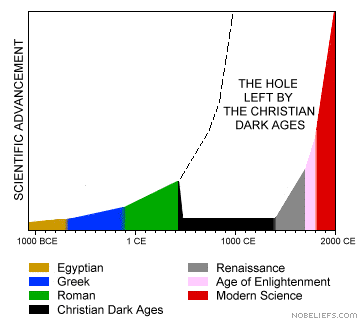
Null presents us with an interesting graphic today:


Discuss.

The graph was produced by NoBeliefs.com, in a (rather ranty) article challenging the claim advanced by some apologists that "without Christianity, we would not have modern science, medicine or hospitals."
The Christian Dark Ages represents the only time in the history of Europe where scientific advancement not only halted but went backwards. The hole left by the Dark Ages bears the imprint of scientific intolerance. Imagine where scientific advancement would stand today if not for the scars left by Christianity.

During the Age of Enlightenment, people began to wake up. Many freethinkers and scientists rejected orthodox religion and replaced it with unitarianism, deism, or non-theistic philosophy. During the 1800s and after, scientists no longer had to fear religious persecution in any form. As never before in the history of mankind, scientists began to reject theocracy entirely. And what happened as a result of the freedom from Christian influence? Science literally exploded with new discoveries! Since the early 1900s, the majority of the world's productive scientists held no theological beliefs, and the percentage of nonbelievers continued to rise every decade.

The idea that Christianity founded modern science and medicine comes from pure arrogant myth. Christianity, by its very biblical nature, represents the antithesis of science.

Monday, October 22, 2007

This post is chiefly inspired by sour grapes on my part: I pride myself on bringing you the latest in matters fundie/theocratic, and GrodsCorp up and steals the march on me. Twice.
Maybe I’m the last guy in Australia to know about this [nope, second last -- AV] but the Gloria Jeans coffee shop franchise is co-owned by two men with close links to the Pentecostal Hillsong Church. In addition to this, Gloria Jeans is a major corporate sponsor of Mercy Ministries which “is a non-profit organization for young women who face life-controlling issues such as eating disorders, self-harm, drug and alcohol addictions, depression and unplanned pregnancy.” Mercy Ministries is strongly anti-abortion and views “lesbianism as a sin that their residential program assists girls to ‘walk in freedom from.’”
It probably shouldn't come as much of a surprise that an icon of materialism (I'm not talking about the philosophical kind; I'm talking about the praise-Jesus-and-pass-the-remote-to-the-plasma-TV-in-my-theatre-room kind) such as Gloria Jeans has such strong links to Hillsong (which, like many evangelical churches, preaches the prosperity gospel) and the religious right.

Close to a decade ago, my sister was involved with Amway and invited me to a meeting. At the time I wasn't aware of its affiliations, but the loungeroom seminar did feel strangely like my sister had invited Mormons or Jehovah's Witnesses into her house to give a presentation. (Later my parents, who (being parents) had attended a few of these meetings, described the atmosphere as "cultish.") The quasi-religious ambience was no accident. In the US, Amway (founded by Rick DeVos) has been a major supporter of conservative politics (see also this article by Bill Berkowitz), disgraced private armies, and religious right causes. From Scoop:
Eric is a good example of this kind of conversion. Before he came into Amway, politics had never been an issue with him, and he was not a deeply religious person. But he soon came to believe that he was dealing with people of great faith and integrity, in part because the tapes he was instructed to listen to.

Unbeknownst to Eric, an educational process had begun that would eventually alter and control nearly all of his values and beliefs. As part of that process, he was instructed to (1) attend choreographed Amway rallies where it delivers its message, often over 2 or three days; (2) read politically charged books; (3) listen to hours of politically slanted audiotapes and voicemail messages; and (4) pay large amounts of money to listen to Right Wing Religious and Republican spokespersons at seminars around the nation.

While attending these seminars, Eric began to learn about the supposed evils of liberalism and the Democratic Party and how the liberals wanted to take from the hardworking, honest people and give to the nonproductive members of society, who were only poor because they were lazy.
I've always thought of evangelicalism as one big pyramid scheme anyway.

OT: What do these two clips have in common?


Sunday, October 21, 2007

Skeptics Annotated Bible provides a long list and a short list of cruelties in the Bible.

Steve Wells of Dwindling in Unbelief has issued a bit of challenge to his Bible-believing readers, and I thought I'd reproduce it here.
And he [Elisha] went up from thence unto Bethel: and as he was going up by the way, there came forth little children out of the city, and mocked him, and said unto him, Go up, thou bald head; go up, thou bald head. And he turned back, and looked on them, and cursed them in the name of the LORD. And there came forth two she bears out of the wood, and tare forty and two children of them. 2 Kings 2:23-24
Are there any Bible believers that are not bothered by this story? If so, I'd like to hear from them.


Well?

Saturday, October 20, 2007

Little Johnnyism is a variant of the argument to authority with which I am sure we are all familiar. When we were kids, Little Johnny was that boy down the street that our parents were convinced we all wanted to emulate. “Little Johnny does the dishes,” “Little Johnny keeps his room clean,” “Little Johnny mows his parents’ lawn,” and so on. The idea is that since we have some attribute in common with Little Johnny—that of being little--we are more likely to be impressed by the moral examples he sets than by those of an older person.

Apologists use Little Johnnyism when they rattle off names of celebrated ex-atheists who have found Jesus and/or God--e.g. Lee Strobel or Anthony Flew—reasoning that, since all atheists obviously think alike, they are equally likely to be impressed by such conversion stories. Some apologists, like Kirk Cameron, will even cite (or, as I suspect, manufacture) their own atheist pre-history and subsequent conversion tale—call it “Little Kirkism”—and then claim to know what all atheists think (and presume to tell atheists what atheists think).

My correspondent Trey himself uses Little Johnnyism when he rattles off a list of scientists—I mean, atheists are bound to be impressed by scientists, right?--who have made affirmative pronouncements on the existence of God/the supernatural.
Robert Jastrow, an astrophysicist, says this in talking about the Big Bang theory and its implications, “Now we see how the astronomical evidence leads to a biblical view of the origin of the world. The details differ, but the essential elements in the astronomical and biblical accounts of Genesis are the same: the chain of events leading to man commenced suddenly and sharply at a definite moment in time, in a flash of light and energy.” In another interview he says, “Astronomers no find they have painted themselves into a corner because they have proven, by their own methods, that the world began abruptly in an act of creation to which you can trace the seeds of every star, every planet, every living thing in this cosmos and on the earth. And they have found that all this happened as a product of forces they cannot hope to discover…That there are what I or anyone would call supernatural forces at work is now, I think, a scientifically proven fact.” Arthur Eddington, a contemporary of Albert Einstein, said, “The beginning seems to present insuperable difficulties unless we agree to look on it as frankly supernatural.”
Sorry, Trey, but this proves nothing—other than the fact that even scientists are as prone to the argument from ignorance fallacy as the rest of us. And how does Jastrow know that the Big Bang was an act of creation? He doesn’t provide any evidence to support his claim—he simply asserts it. Creation implies a Creator. Add begging the question to that list of logical fallacies to which scientists might also be prone—particularly when they are speaking on matters that lie outside the purview of science, such as the supernatural. (Incidentally, it turns out that Jastrow also speculated that “the Big Bang may have been one of a series of cosmic explosions that alternate with cosmic collapses.” Ah, the pitfalls of quote-mining!) Trey goes on:
What they are talking about observing is that the universe and cosmos have a definite beginning. The Law of Causality tells us that everything that had a beginning has a cause. The cosmos have a beginning; therefore, it must have a cause. That cause must be eternal, timeless, infinitely powerful, etc. to have done this, which are characteristics remarkably like theistic God.
Firstly, while the Big Bang theory may suggest that the universe had a beginning, the cosmos is a different matter—google “multiverse theory.” Secondly, how does Trey know that whatever caused the cosmos did not itself have a beginning? How does he know that whatever caused whatever caused the cosmos did not itself have a beginning? And so on. Trey offers more scientists offering arguments from ignorance/incredulity:
Astrophysicist Hugh Ross took into account all the constants that are necessary to sustain life as it does not on earth, 122 in all, and what we know of the number of planets in existence, 10^22, and found that probability to be 1 IN 10^138. There are an estimated 10^70 atoms in the universe, so that number is absurdly high. Given that the universe is not eternal and did have a beginning, there is zero chance that natural nomena could explain existence. Nobel Laureate Arno Penzias said, “Astronomy leads us to a unique event, a universe which was created out of nothing and delicately balanced to provide exactly the conditions required to support life. In the absence of an absurdly-improbable accident, the observations of modern science seem to suggest an underlying, one might say, supernatural plan.” To which you say and many atheists would say, “Nu-uh, that event happened. Shutup, science!” and I and my theists buddies would say, “Good work science. Seems reasonable to me.” However, the fact that that event cannot be recreated means that we will never know exhaustively what happened. This means that, regardless of how much support we get, there will be a need for some amount of faith in any conclusions.
Astrophysicist Hugh Ross--note the Little Johnnyist marker-- is an old earth creationist, and a detailed critique of his ideas on fine-tuning can be found here (see also this post by P Z Myers), but he’s basically making a “God of the Gaps” argument (“I can’t explain it, therefore goddidit”), as is the Nobel Laureate Arno Penzias. Nothing to see here, people. Of course in science we will never know exhaustively what happened with regard to past events such as the origin of the Earth, the solar system, or the Universe—the best we can do is arrive at sound models based upon the evidence we have. Isn’t that better than simply throwing our hands in the air and proclaiming “we don’t know . . . therefore goddidit”?

Wednesday, October 17, 2007

OH NOES!! The Chaser boys have offended some people again with a song that appears to take the piss out of dead celebrities, including Steve Irwin, Princess Di, Kerry Packer and Stan Zemanek (but is really just commenting on the hypocrisy of eulogizing those whom we found cause to dislike when they were still breathing).


Cue the hyperventilating . . .

"CHASERS WAR ON GOOD TASTE" wails Ninemsn. "To disrespect people have passed [sic] is cruel!" moans Deb of Adelaide, in the Ninemsn forum on the topic. On the ABC's own message board (and according to News.com, "Irate viewers rang the ABC switchboard to complain about the song after it aired and talkback radio hosts were inundated with comments about its content"), habbo1 whines: "A long time fan of Chaser, great dissapointment in the cringe factor that was last night 'dead celebrity bashing.' Juvenile, pathetic humour that we are to expect from Commercial TV's attempt to be 'controversial.'" I'm certain there's more to come. (UPDATE: And I was right.)

What a bunch of tightarse, whinging fuckpigs (as Billy Connolly would say).

This reminds me of when Sean Hannity was sooking about what a big meanie Christopher Hitchens was for the latter's criticisms of the late Jerry Falwell:


Tuesday, October 16, 2007


The Carnegie-Knight Initiative on the Future of Journalism Education, a collaboration between five leading US universities, has created an interactive tool for gauging the role played by religion in the 2008 Presidential Election campaign.


The following is an interactive matrix examining the intersection of faith and politics on the stump as presidential hopefuls line up for their chance to win the White House in 2008. Issues range from abortion and public education to religious history and gay rights. Every candidate so far declared for office has been thoroughly researched for any mention of faith and its impact on their decision to reach a particular stance. Use the following matrix to explore how faith has been invoked as a part of their respective campaigns.

(You'll have to go to the site to open the tool.)


It would be extremely handy, don't you agree, if a similar tool was made available for Australian election campaigns.

Actually, those of you who are familiar with the website Political Compass will be interested to learn that a chart has been made for the 2007 Federal Election:


The extent to which the political centre of gravity is sinking deeper and deeper into the right-wing authoritarian quadrant is truly disturbing. Looking at the party's website (which basically resembles one long angry Letter to the Editor from Joe Incontinence Pad), I can understand how difficult it must have been for the Political Compass guys to place One Nation. They are undoubtedly authoritarian--well, let's just come right out and say it: they're protofascist--but in terms of economic policy they can be both left-wing and right-wing. (For instance, they're stridently anti-corporate: they even link to the Outfoxed website!) By the way, secularist potential One Nation voters be warned: your party advocates the teaching of Scripture and "Christian values" (whatever they are supposed to be) in public schools. And oil is--and this must be said in ALL CAPS, just like it is on the One Nation website--A RENEWABLE AND ABIOTIC FUEL."

In other news, I've submitted Five Public Opinions to Blogotariat, a political blog aggregator. Bruce, Mikey, Jeremy, the Editor . . . all the cool kids are doing it.
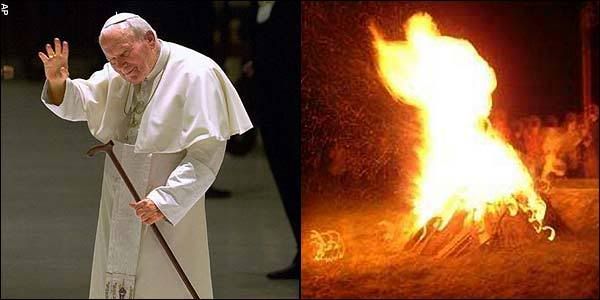
Here's an interesting photo taken recently in Poland . . .


AND UNLESS YOU CAN PROVE OTHERWISE, THE DEFAULT EXPLANATION IS THAT POPE JOHN PAUL II HAS INCARNATED HIMSELF IN A BONFIRE!!!!!!!!!!!!!!!!!!!!!!!!!!!!!!!!!!!!!!!!!!!!!!!!!!.

While credulous theists the world over are once again basking in their own insipidness, a new voice of reason has emerged on the Australian political landscape. I mentioned it in passing on Sunday, but the Secular Party of Australia will be fielding candidates for the Senate in this year's federal election. Jen of Unsane and Safe fame will be running, which is good news, because I vote below the line. I wish her the best of luck: Ganbatte!, as they say in Japan.

As for the party's policies, there is very little that I disagree with, except this one: "We stand against . . . The wearing of religious attire in schools." As long as no one is compelled to wear religious attire, and as long as the wearing of such attire does not hinder the wearer's ability to participate in classroom activities, I don't see how it infringes anybody else's rights. (And the Party does claim, elsewhere on the site, to "believe that people should be free to indulge their beliefs, provided they do not infringe the rights of others.") Indeed, banning the wearing of religious garb, I believe, is just as anti-democratic as enforcing religious observance. (You might say that it amounts to the state overstepping the boundary between church and state.) I'd be interested to hear the thoughts of a representative of the Secular Party on this issue.

Monday, October 15, 2007

Many of the entries in my “More Unconvincing Arguments for God” series, while certainly inspired by the list at Friendly Atheist, are partly based upon email correspondence with Trey, a commenter at Unorthodox Atheism. (And I do wish to emphasise that not all of the arguments I am critiquing are those which Trey would necessarily endorse.)

I find that many of Trey’s arguments are based upon appeals to ignorance/incredulity--“I can’t explain how x happened, therefore God caused x (therefore God exists)” or “I find it very hard to believe that x can be explained naturally, therefore God caused x (therefore God exists)—-and I think I’ve pointed this out to him on several occasions, along with other logical fallacies in his argument. In response, Trey has sought to undermine the very notion of rational critique by defining reason as another kind of “faith”:
You use reason, correct? How do you know reason works? A circular argument would be that reason tells you reason works, which is insufficient. So how do you know? Could it be that you have faith in reason? In logic? How much of your own sentiments do you see mirrored in those of the scientists that “detest” the idea of God? Doesn’t that give you pause and make you at least think that you stance is not as founded on reason and logic as you would like to think?

Trey replied thus after I had endeavoured to explain to him the grounds of my atheism: “I'm an atheist because, there being no evidence of the existence of deities, there is no reason to believe in them.” Elsewhere, he has argued to the effect that I only demand evidence of God’s existence because I have naturalist “presuppositions”, and therefore I have no grounds to critique his presuppositionalism. (This, by the way, is an example of a tu quoque fallacy—but then fallacies are part of the vocabulary of reason and reason is just another kind of faith. Rinse. Repeat.) But let me respond to some of his comments above.

First, how do I know reason works? Well, it depends upon what I think reason is capable of. Can reason prove or disprove the existence of God? No. Reason is a method, not a doctrine or dogma—which is why it has routinely been used by theists and non-theists alike. Its purpose is not to prove the capital T Truth of a given claim, but to evaluate the arguments advanced in support of or against the claim. And if we posit the scientific method as reason/critical thinking par excellence, the history of modern science demonstrates that reason works very well, thankyou. Every Christian who opts to consult a physician, as opposed to a faith healer or shaman, when he or she is feeling unwell, is affirming the reliability of reason. (Whether or not he or she realizes it.)

Second, by attempting to undermine reason, Trey is shooting himself in the foot. He claims that reason doesn’t work because “a circular argument would be that reason tells you reason works, which is insufficient.” But if reason is unreliable as Trey is trying to show, then so too is the notion of a circular argument, non? In other words, he’s trying to demonstrate the unreasonableness of reason . . . using reason! So even Trey believes that reason works. Moreover, argument itself depends upon the idea that reason works—that reason is a reliable method for separating (in this case, theological/philosophical) wheat from chaff—and elsewhere Trey has cited some of the traditional arguments for God’s existence (very poor arguments though they may be) in support of his own beliefs. The point is this. If you enter into the kind of debate Trey and I are having, you make a tacit agreement to submit your arguments to rational critique. Some bloggers I have encountered take this kind of critique as a personal attack, but Trey, to his credit, has not. But I do think his attack on reason is little more than an attempt to avoid addressing some of the flaws/fallacies in his arguments.

(Trey might respond as many an apologist has done: he can use logic and reason because God invented logic and reason. But if such is the case, then square circles are possible. Why? Because if God invented logic, then he is not bound by its rules, and therefore has the ability to make square circles, which are logically impossible. Other apologists have argued that God’s omnipotence means only that he can do all that it is logically possible to do; and since square circles are not logically possible, God can’t make them. But on this view, God is bound by the rules of logic, and therefore cannot have invented logic. Quite the conundrum.)