It's noble to start a blog with intentions of changing people's opinions. That kind of idealism is something beautiful but unfortunately, rather deluded. It is in the nature of the reader to seek out information that reaffirms their beliefs, not challenges them. Aldous Huxley said that we live in a sea of island universes, perpetually separated from the experiences of others. We can share something with another person but we cannot truly place ourselves in their shoes. Still, despite our isolation, most of us are comfortable enough within ourselves and particularly, with our own personalised view of reality.
Within this view of reality, we are inherently informed about right and wrong, good and evil and beauty and ugliness. Each event in our lives moulds us into who we are and shapes what we believe. Our attitudes and values towards the world, other people and other beings all struggle to maintain their integrity. Although our lives are in a constant state of transition, we resist it. Apathy becomes the easiest option. We lose any sense of self determination, yielding to the whims of sloth, losing that childlike ability to accept things as they are, yet working to change them.
Accepting this notion, as a writer especially, is difficult. A writer, or anyone who expresses themselves through a craft, would like to believe that they act not only out of love for that craft, but out of the ability to inspire others to behave or think in a way that is out of the norm. Art is an egocentric process only in the sense that artistic work should have an impact on the world and not remain locked in a vacuum, only to be looked upon by the person who created it. So to accept that people are conservative by nature, that they will always resist your images and words, is rather depressing. It makes the author question their sense of identity, and moreover, their sense of purpose.
Merely reaffirming a reader's views is a hollow practice, in spite of the sense of camaraderie that it may foster. It's like reading books with the same plot structure over and over again. We begin to accept that a certain structure is more valid than others and then begin to get comfortable with it, forsaking everything new. Authors want to illuminate, to click with something in the reader's mind that was previously inactive and neglected. The human mind needs constant stimulus, as nothing quite compares to that little jolt of euphoria you experience when you've learned something completely and utterly new.
Thursday, November 15, 2007
- Describe my earliest memory where the memory is clear, and where "clear" means I can depict at least three details.
- Give an estimate of my age at the time.
- Tag five other bloggers with this meme.
When I was very young I used to share a bedroom with my younger sister. It was an upstairs bedroom in a two-storey house, and where we join the action I was lying on the upper bunk or our bunk bed. I can remember the curtains in the room, which I liked, even if--for reasons unknown--I found them a little scary. (They depicted schooners and ships.) I remember looking beyond the curtains and across the road to where a vacant lot stood. It was just bushland surrounded by houses, and there was a large rock in the middle of the lot which, if you were looking at it from my angle and vantage point, resembled a human face.
I guess that was the first time I noticed it--my sister and I would often remark upon it for years afterwards, until the lot was eventually bought and developed. I think we even tried to locate it once.
Oh great. My earliest memory turns out to be a case of pareidolia.
(By the way--I think I was about three at the time.)
I, in turn, tag Sean, Lucy, Madd McColl, Backyard Missionary and Ninglun.
Dan Dennett on the meme:
Tuesday, November 13, 2007
Tuesday, October 23, 2007
PG!! Apparently it's because my blog contains two mentions of the word "abortion," and one of the word "torture." I guess images such as this or this are now kosher.
(Via Chris, who managed to score an "R" rating.)
This ought to fix it:
Thursday, September 27, 2007
Super Simmo is one of the few bloggers on my sidebar that I know personally. He's a teacher in Perth who regularly posts on politics (and rugby union, and games) with passion and conviction.
Now it appears that he has deleted his blog; at least, it seems so: Blogger displays in Japanese characters over here. He did mention starting a new blog,
Simmo--if you're reading this, let me know what's going on.
Anyway, this is for you, Simmo:
And in the light of recent events . . .
Thursday, June 14, 2007
The atheist blogosphere is growing apace, much faster at any rate than Alister McGrath can publish anti-Dawkins tomes. Mojoey has amassed hundreds of such blogs on his Atheist Blogroll, and if you would like to join, click here.
Just to make it worth your while:
The Atheist Tapes parts 1 and 2: Daniel Dennett
UPDATE: Here's a great atheist blog I just discovered today.
Monday, May 28, 2007
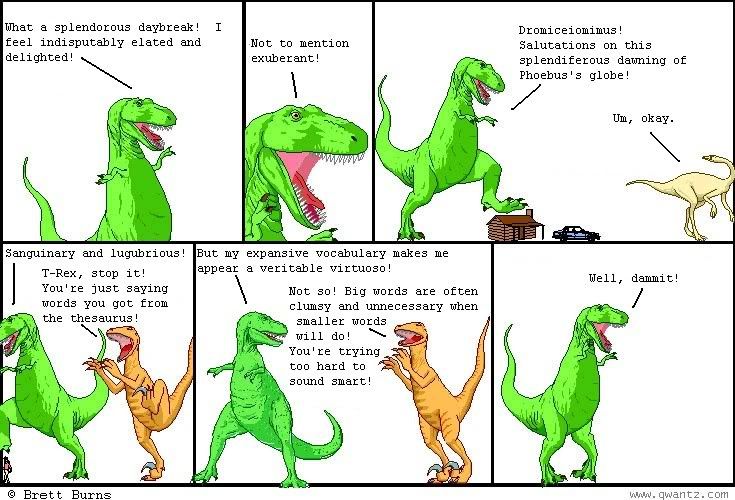
Presuppositionalist apriorism also rears its ugly head in debates about whether atheists can be moral, whether evolutionists can be moral, etc.Granted: it's not the kind of language you're likely to hear at the footy, but the idea that it demonstrates my having delusions of grandeur is completely nonsequitous (oops! Another big word). The only explanation I can come up with is that whenever this individual sees someone using TEH BIG WORDS, he concludes that it's all part of a conspiracy to make him feel stupid. Bruce and I only used TEH BIG WORDS, you see, because we think we're betterer than him.
Well, my friend, I've got another big word for you: projection.
P.S. I'm actually something of an advocate for plainer English. When I was teaching essay writing earlier in the year, I was amazed at how difficult it was to disabuse my students of the myth that they would get bad marks if they didn't use unnecessarily big words (many of which they plainly misunderstood anyway) and convoluted prose. They were convinced that to adopt a simpler approach would be to appear "unprofessional"--as if maintaining an image of professionalism is more important than getting a message across.
On the other hand, it is possible to be too zealous about the push for simplified prose. The basic presupposition of the Plain English movement is that anything and everything can and should be expressed in terms accessible to "the man in the street." I say, however, that plain English is good only when it clarifies a message; plain English is bad when it dilutes or dumbs down a message. (I'm thinking here of those plain English versions of Shakespeare they're using (not exclusively, I hasten to add) in high schools these days.) As Einstein said: "Make everything as simple as possible, but not simpler."
In any case, whatever my friend's agenda, I really don't think it's as innocuous as a call for plainer English.
Monday, May 21, 2007
Well, as Bruce has declared, enough's enough.
Bye-bye, ta-ta, theocrats take your disingenuous political stunt with you. YouThat's right, fundies--the evil secularist babykilling hordes are fighting back. Let May 26th henceforth be known as The National Day of Secularism!
haven’t fooled me or anyone else with a functioning brain.
This is a tagging meme, so I'll let Bruce tell you the rest:
How the “meme” works
This “meme” works in two steps; first the “Tagging stage” and then the “Blog against theocracy stage”.Tagging stage
If you are tagged by the meme, then it’s the same old format; mention this entry so
people can see the rules and then tag five other bloggers (preferably Australian given the nature of the NDoT.) You can link back to these rules and display the above (rather modest) banner by inserting this code at the end of your entry(Check Bruce's post for the code--Blogger won't let me post it here)
Feel free to copy the PNG file to your own host and alter the code accordingly, and remember when entering the code to enter it into the “code” window of your blog editor (blogger and wordpress users, I know there is a tab for this above your editing window)!This meme does however have somewhat of a difference; an additional stage…
Blog against theocracy stage
If you have been tagged (heck, even if you haven’t, it doesn’t bother me) then in addition to tagging others, it is also hoped that you will write a blog entry about the separation of Church and State in Australia. It could be a critique of Pell’s “normative democracy”, the historic anti-democracy sermonizing of Archbishop Daniel Mannix, inevitable discrimination by the funding of (approved) chaplains in public schools, the state backed imposition of bans on forbidden women’s dress or whatever Church-State issue you find important.Preferably, such a blog entry would be published on the 26th, but I’ve been lazy in getting around to this and I’ve left people little time so there is no deadline as such.
Just a couple of caveats; 1) the church-state anti-theocracy blog entry should mention the phrase “National Day of Thanksgiving”, possibly mentioning that the entry is a response to the NDoT, and 2) feel free to add the (again admittedly modest) banner.
I, in turn, tag the following: A Churchless Faith, BeepBeepIt'sMe, Smogblot, Super Simmo and The Dog's Bollocks.
UPDATE: We haven't spoken too soon, evidently. John Howard courted uber-fundies Catch the Fire in January; now Kevin Rudd's at it. Now let me get this straight. They umm and aahh and fiddle with their diaries when it comes to meeting the Dalai Lama, but they're falling over themselves to court an organisation whose leader claims to have personally met Jesus "face to face on 21st July 1997 at 3.40am (He spoke to me for 2 hrs. 20 minutes.);" who in the run-up to the 2004 election called on his followers to pull down "Satan's strongholds," including brothels, gambling places, mosques and temples; and who in 2005 addressed a meeting of the Australian League of Rights.What's going on here? First the Exclusive Brethren, and now Catch the Fire? Has the batshit insane fundie vote really become that significant?
Friday, April 13, 2007
Admittedly, at #90 I'm in the lower echelons of said rankings, but then again, never look a gift horse, etc. In any case, I'm both humbled and ashamed--there are many Australian bloggers, including those listed in my sidebar, who deserve more attention.
Congratulations also to Larvatus Prodeo (#25), Deltoid (#27) and Mr Lefty (#39).
UPDATE: On the subject of great Aussie blogs, Grods has a wonderful post up about teaching.
Friday, February 23, 2007
1. Because little Kimberley Anne is dying of a horrible disease.
2. Because I have tried this twice -- the first time I made about $1,200, and the second earned me just over $2,000!
3. Because I will experience great sex within four days of receiving this meme, provided I send it on!
4. Because Carlo Caditt, an office employee, received the meme. He forgot it and a few days later he lost his job. He found the meme and sentit to 20 people. Five days later he got an even better job. Dolon Fairchild received the meme and not believing it, threw it away. Nine days later he died..
5. Because every meme I answer releases a soul from Purgatory.
I, in turn, tag yepthatsgold.
Saturday, February 17, 2007
Hitler got the fascists sexually aroused. Flags, nations, armies, banks get a lot of people aroused (Gilles Deleuze)
There are no eternal facts, as there are no absolute truths. (Friedrich Nietzsche)
Morality is the herd-instinct in the individual. (Nietzsche again)
Enlightenment is man's emergence from his self-imposed immaturity. Immaturity is the inability to use one's understanding without guidance from another. This immaturity is self-imposed when its cause lies not in lack of understanding, but in lack of resolve and courage to use it without guidance from another. Sapere Aude! [dare to know] "Have courage to use your own understanding!"--that is the motto of enlightenment. (Immanuel Kant)
The strategic adversary is fascism... the fascism in us all, in our heads and in our everyday behavior, the fascism that causes us to love power, to desire the very thing that dominates and exploits us. (Michel Foucault)
I, in turn, tag Lucy, Mikey, Jacob and Simmo.
Monday, February 12, 2007

I was watching an old episode of Seinfeld the other day ("The Truth")--having just finished viewing An Inconvenient Truth and a few episodes of The Awful Truth--and I proceeded to ask myself: What is truth? Andre Gide once opined: "Believe those who are seeking the truth; doubt those who find it." On the other hand, Blaise Pascal observed that "We know the truth, not only by the reason, but also by the heart." Then again, Pascal held that "There are truths on this side of the Pyrenees, which are falsehoods on the other." (I shit you not.)
"Always tell the truth," Mark Twain advised. "That way, you don't have to remember what you said." "Truth," David Hume believed, "springs from argument amongst friends." Edward R. Murrow felt that "Most truths are so naked that people feel sorry for them and cover them up, at least a little bit." George Eliot agreed: "Falsehood is easy, truth so difficult." Another George--Orwell--put it even more bluntly: "In a time of universal deceit, telling the truth becomes a revolutionary act." Hence Noam Chomsky's contention that "It is the responsibility of intellectuals to speak the truth and expose lies."
Truth to tell, it's not all bad news. Max Planck once declared that "It is not the possession of truth, but the success which attends the seeking after it, that enriches the seeker and brings happiness to him." For Ralph Waldo Emerson, "Truth is our element." "The truth is always exciting," said Pearl S. Buck. "Speak it, then. Life is dull without it."
I'll leave the last word to Gloria Steinem: "The truth will set you free. But first, it will piss you off."
(Via The Uncredible Hallq)
Sunday, February 11, 2007
Saturday, November 25, 2006
It's official: Five Public Opinions has a troll site.
UPDATE:
Related posts:
To Fisk or Not to Fisk? (Ninglun)
It's Not Fisking: It's Cybermolestation (Bruce)
UPDATE II: If for whatever perverted reasons of your own you've been following this saga, it would appear that the troll site in question is either disbanded altogether, or has shut itself off from the outside world completely. So, if you're wondering why you can't access the site: that's why.
Monday, November 20, 2006
How to Talk to Atheists
How to Talk to Believers
The quality of discourse there, so far, has been very impressive. Why don't you stop by?
Tuesday, November 14, 2006
(There. I've said it. You know the content of the image (NSFW). You know the context. I'm not going to link to it--so track it down at your own risk.)
Before we proceed . . . I think there is an inherent risk in publishing gruesome or grisly images of the dead with the intent of "shocking" viewers into supporting your cause. Such images have a tendency to rob their subjects of their dignity, and you may find that the outrage generated by the image ends up being directed squarely at you. The litmus test can be summed up in a simple question: does viewing this image advance our knowledge of the situation? In the case of, say, the Abu Ghraib images, I would say: yes. In the case of the image on Seeking Utopia: we know already that innocents are being slaughtered in the Israeli-Palestinian conflict, so does publishing this image achieve anything beyond robbing the dead infant of her dignity? I think not.
Anyway . . .
Friday, July 28, 2006
I have just come across a wonderful interview with the philosopher Martha Nussbaum on the topic of the deleterious role played by disgust and shame in public policy and discourse surrounding important social issues. You might even say her argument establishes the appeal to disgust as a logical fallacy--though she is careful to emphasise that emotion can have a legitimate role to play in reasoning:
Some emotions are essential to law and to public principles of justice: anger at wrongdoing, fear for our safety, compassion for the pain of others, all these are good reasons to make laws that protect people in their rights. [. . .]Nussbaum cites recent debates around same-sex marriage and gay rights--including, for example, claims that "gay men eat feces and drink raw blood"--as examples of public discourse that regularly invoke disgust to persuade people to adopt a particular point of view. Videos of abortions produced for public consumption by anti-abortion groups also spring to mind. There is a case to be made, perhaps, that images of dead, wounded or disfigured women and children--which might be used to bolster both pro- and anti-war arguments--also constitutes an appeal to disgust.
Disgust, I argue (drawing on recent psychological research), is different. Its cognitive content involves a shrinking from contamination that is associated with a human desire to be non-animal. That desire, of course, is irrational in the sense that we know we will never succeed in fulfilling it; it is also irrational in another and even more pernicious sense. As psychological research shows, people tend to project disgust properties onto groups of people in their own society, who come to figure as surrogates for people's anxieties about their own animality. By branding members of these groups as disgusting, foul, smelly, slimy, the dominant group is able to distance itself even further from its own animality. [. . .] Unlike anger, disgust does not provide the disgusted person with a set of reasons that can be used for the purposes of public argument and public persuasion.
What do you think? Is the appeal to disgust a logical fallacy, and should it be avoided?
I'd like to draw your attention to a new link on my sidebar (under "Politics, Philosophy and Slave Morality": if I knew how to upload graphics to the Blogger template, I'd use the banner above): The Best of Net Atheism. And by the looks of it, this atheism thing is developing into quite the cottage industry: The Best of Net Atheism links to an atheist film reviewer, an atheist radio station, an atheist teen site, and even an atheist dating service. (You'll find yours truly listed there, too ;))
There's something unsettling about all this. Scrolling down the list I find the whole endeavour eerily reminiscent of the parallel popular culture fashioned by Pentecostal/Evangelical Christians in an endeavour to close themselves off from the evil secular world*. (Perhaps this has something to do with the fact that many of the sites are operated by deprogrammed evangelicals.) What worries me is the possibility that atheists might be developing a similar kind of siege mentality--and atheists have less to fear from reality than certain of their faith-based counterparts.
Then again, maybe what atheists need--and remember, they're even more unpopular than Muslims and homosexuals in America (Australian data is unavailable at this time)--is a little evangelical zeal!
*For comic relief, have a look at Landover Baptist's TrueChristian TV Guide.
Saturday, November 11, 2006
New Lines from a Floating Life
Religion and politics in the USA: nonstereotypical view
A particularly Australian decency
Bruce's Rave and Rant
My farewell post to "Seeking Utopia" (a.k.a "Secretly Seeking Kool-Aid")
Metablogging Blog Implosions: Timorous and Callow
Also noteworthy:
Slacktivist's rejoinder to Jim Wallis' strawman attack on the "Secular Left."
Another strawman attack on the "Secular Left" that desperately deserves fisking (Radio National: "Ockham's Razor")
Wednesday, October 25, 2006
1-Do you like the look and the contents of your blog?
Not particularly. But HTML-illiterate beggars can't be choosers. I love the contents of the sidebar, however :)
2-Does your family know about your blog?
My immediate family? No. But only because it wouldn't interest them. My girlfriend knows about it. It doesn't interest her, either.
3-Can you tell your friends about your blog? Do you consider it a private thing?
A couple of my friends know about it: one them actually introduced me to blogging in the first place. Do I consider it a private thing? On the one hand, it's on the internet, so how private can it be? On the other hand, I do use a nom-de-plume.
4-Do you just read the blogs of those who comment on your blog? or you try to discover new blogs?
I read other blogs far more than I post to my own: and the bloggers whose sites I frequent the most are also those with whom I have never exchanged correspondence (i.e. Pharyngula and Dispatches from the Culture Wars). At the same time, I like to discover good Australian blogs, and especially Perth blogs.
5-Did your blog positively affect your mind? Give an example.
I have developed an interest in critical thinking--particularly how it can be applied to education--since I started blogging. Bruce and others have been helpful in this regard. Discussions--some more heated than others--with various bloggers have helped me to clarify my own position re: atheism and religion.
6-What does the number of visitors to your blog mean? Do you use a traffic counter?
It means I have a small, respectable circle of readers.
7-Did you imagine how other bloggers look like?
It rarely crosses my mind, truth to tell.
8-Do you think blogging has any real benefit?
Absolutely. I know this sounds cliched, but I really do believe in the potential of blogs to assume the fourth-estate responsibilities that the traditional media is abandoning. Blogging has also, I would say, reconnected people with the art of good writing. Is it mere coincidence that Strunk and White's Elements of Style has become so popular in the age of blogging?
9-Do you think that the blogsphere is a stand alone community separated from the real world?
Some bloggers give you the impression that they haven't been acquainted with the real world in a very long time.
10-Do some political blogs scare you? Do you avoid them?
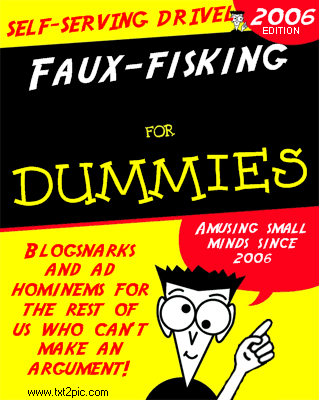
I stay away from those blogs where it is assumed that rants and ad hominems are substitutes for argument. They aren't.
You know the sort I'm talking about: authoritarian-righty types who brook absolutely no dissent, and are so scrupulously obsessive about this point that they scour the internet for the slightest hint of criticism or scorn, then send in the brownshirts when they locate it. They are the blogosphere's answer to happy-slappers and Werribee boys. Scum.
11-Do you think that criticizing your blog is useful?
As a student-teacher, I'm trained to believe that self-reflection is a virtue.
12-Have you ever thought about what would happen to your blog in case you died?
It would doubtless be eaten by spam.
13-Which blogger had the greatest impression on you?
A close tie between Ed Brayton and P Z Myers.
14-Which blogger do you think is the most similar to you?
A close tie between Sammy Jankis and Bruce Everett.
15-Name a song you want to listen to?
Pendulum vs Freestylers: "Fasten Your Seatbelt"
I, in turn, tag: Sammy Jankis, Tedalog Lite, and Bruce.